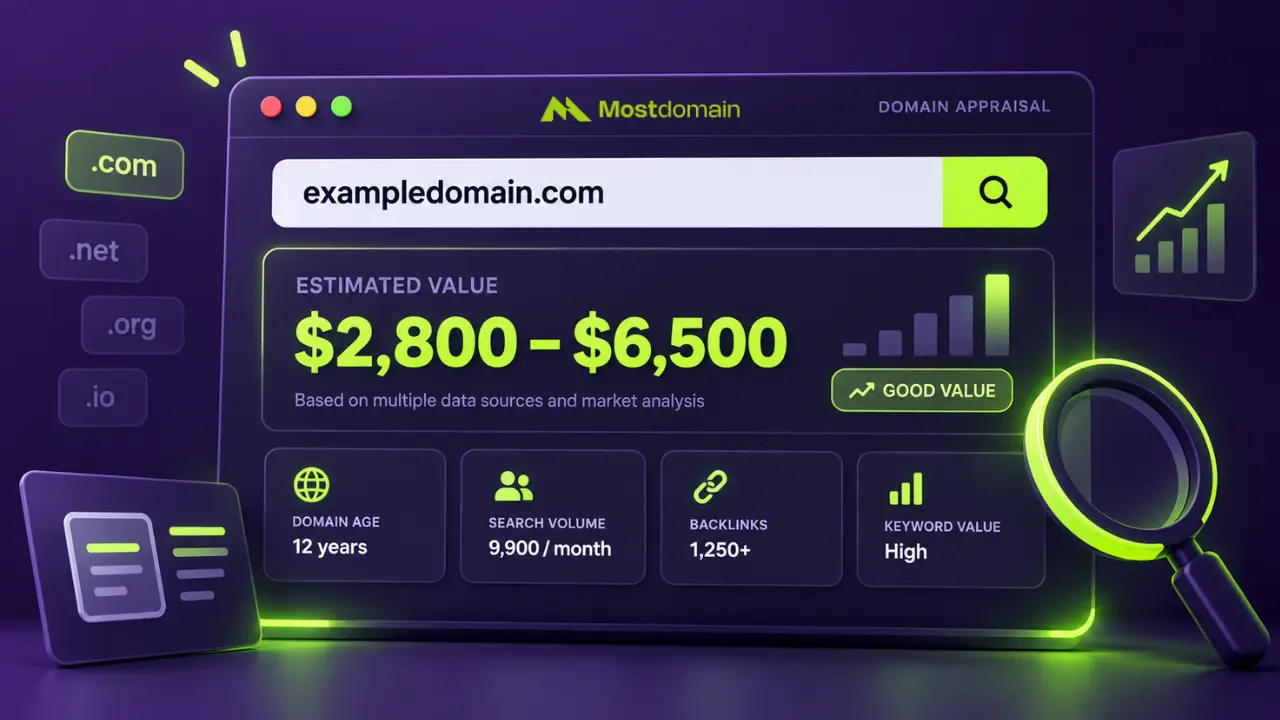
No single number answers how much is my domain name worth. Only a range exists, shaped by length, extension, keywords, traffic, and whoever happens to want the name badly enough to pay for it. Free tools get close enough to be useful. Exact isn’t really on the table, since domain value was never a fixed fact sitting in a database waiting to be looked up.
That answer alone isn’t much use without a way to actually act on it. This article covers the real factors buyers pay for, which free tools are worth trusting and which aren’t, why three different appraisal tools can return three wildly different numbers for the same domain, and what to do once an estimate is in hand.
Nothing here wanders into anything else domain-related outside valuation itself, just worth, how to measure it, and what to do with the number once it’s in hand.
What Actually Drives a Domain’s Price Tag
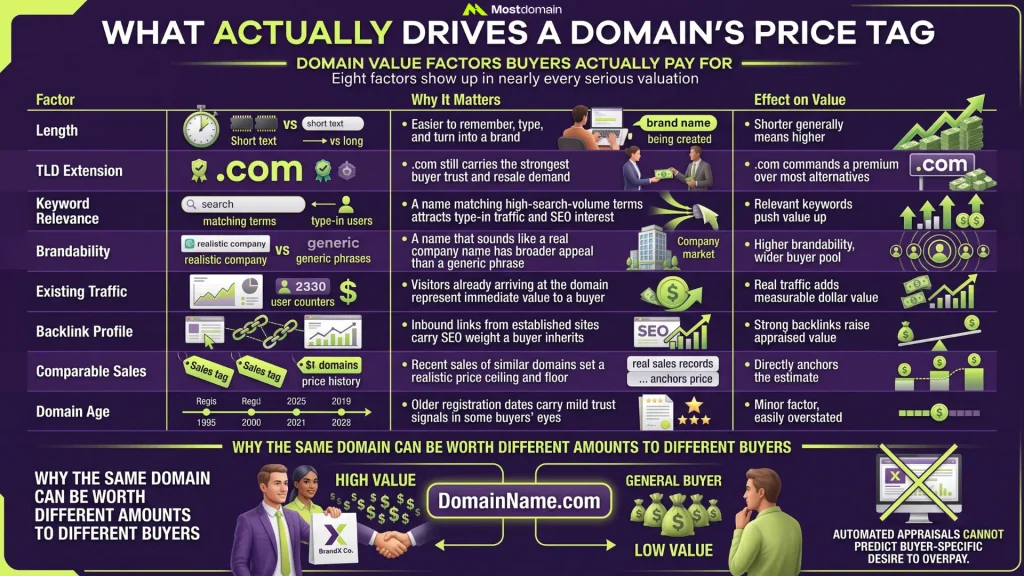
Buyers pay for a specific combination of traits, not the domain itself in the abstract, and the same name can be worth ten times more to one buyer than another depending on how well it fits their exact plans.
Domain Value Factors Buyers Actually Pay For
Eight factors show up in nearly every serious valuation, whether it’s an automated tool or a human appraiser doing the math.
| Factor | Why It Matters | Effect on Value |
| Length | Easier to remember, type, and turn into a brand | Shorter generally means higher |
| TLD extension | .com still carries the strongest buyer trust and resale demand | .com commands a premium over most alternatives |
| Keyword relevance | A name matching high-search-volume terms attracts type-in traffic and SEO interest | Relevant keywords push value up |
| Brandability | A name that sounds like a real company name has broader appeal than a generic phrase | Higher brandability, wider buyer pool |
| Existing traffic | Visitors already arriving at the domain represent immediate value to a buyer | Real traffic adds measurable dollar value |
| Backlink profile | Inbound links from established sites carry SEO weight a buyer inherits | Strong backlinks raise appraised value |
| Comparable sales | Recent sales of similar domains set a realistic price ceiling and floor | Directly anchors the estimate |
| Domain age | Older registration dates carry mild trust signals in some buyers’ eyes | Minor factor, easily overstated |
Why the Same Domain Can Be Worth Different Amounts to Different Buyers
Match a company’s exact brand name with a domain, and that company will pay vastly more for it than anyone else on earth would, which explains why sale prices swing so widely even between names with similar length and keyword strength. A tool has no way of knowing which company might want a name badly enough to overpay for it, so this kind of buyer-specific value almost never shows up in an automated appraisal.

How to Get an Instant Estimate of Your Domain’s Worth
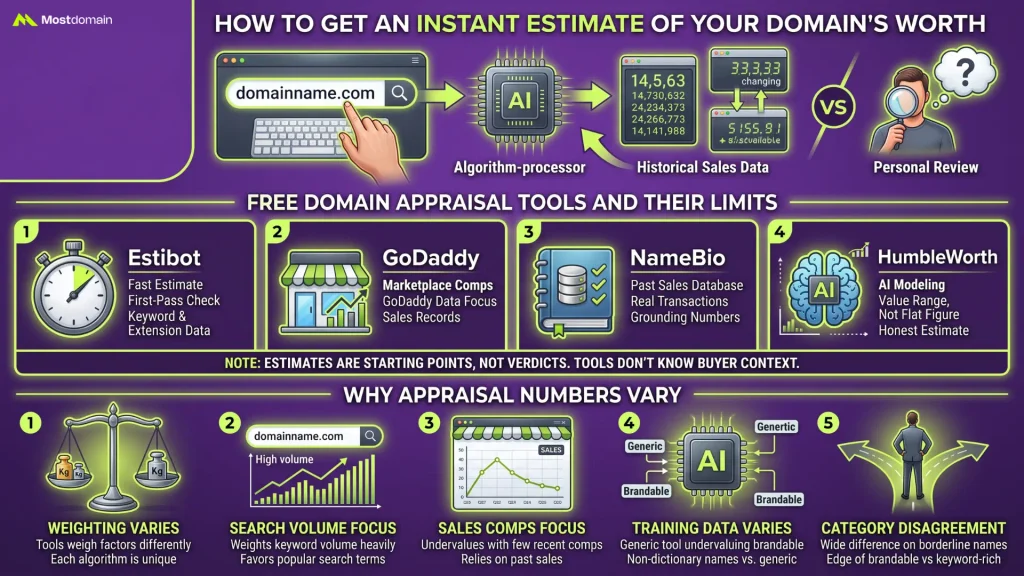
Typing a domain into a free appraisal tool returns a number in seconds, drawing on algorithms trained against historical sales data rather than a human reviewing the name personally.
Free Domain Appraisal Tools and Their Limits
- Estibot analyzes keyword data, length, and extension to produce a fast estimate, widely used as a first-pass check
- GoDaddy’s appraisal tool leans heavily on comparable sales within its own marketplace data
- NameBio isn’t an appraisal tool exactly, it’s a searchable database of actual past sales, useful for grounding any other tool’s number in real transactions
- HumbleWorth leans on AI-driven modeling and often hands back a value range instead of one flat figure, arguably the more honest approach of the four
None of these tools know anything about a buyer’s personal or strategic reasons for wanting a specific name. Treat every free estimate as a starting point, not a verdict.
Why Three Tools Can Give Three Different Numbers
Different tools weigh the same factors differently, and that alone explains most of the gap when three tools return three different numbers for one domain.




- Some algorithms weight keyword search volume heavily, favoring domains that closely match popular search terms
- Others lean more on historical sales comps, which can undervalue a domain if few similar names have sold recently
- Training data varies by tool, and a tool trained mostly on generic keyword domains tends to undervalue brandable, non-dictionary names
- A domain sitting right at the edge of two categories, borderline brandable and borderline keyword-rich, tends to produce the widest disagreement between tools
Closing the Gap a Free Tool Leaves Open
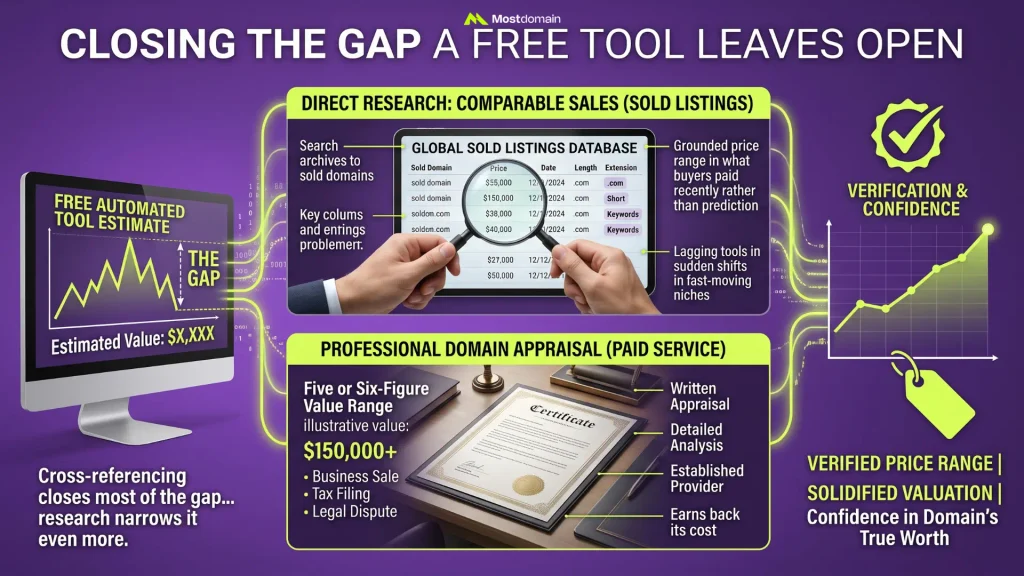
Cross-referencing multiple sources closes most of the gap a single automated tool leaves open, and going further into direct research narrows it even more.
Researching Comparable Domain Sales
A grounded price range comes from searching NameBio or a marketplace’s own sold-listings archive for domains with similar length, keyword theme, and extension, based on what buyers actually paid recently rather than what an algorithm predicts they might pay. This step pays off especially in a fast-moving niche, where algorithmic tools tend to lag behind sudden shifts in demand.
Getting a Professional Domain Appraisal
Once a domain’s estimated value climbs into five or six figures, or the number needs to hold up for something formal like a business sale, tax filing, or legal dispute, a written appraisal from an established provider earns back its cost over a free instant tool. Sedo Domain Appraisal breaks down what one established paid appraisal service actually delivers for that price.
How Much Your Domain Is Worth If You Actually List It for Sale
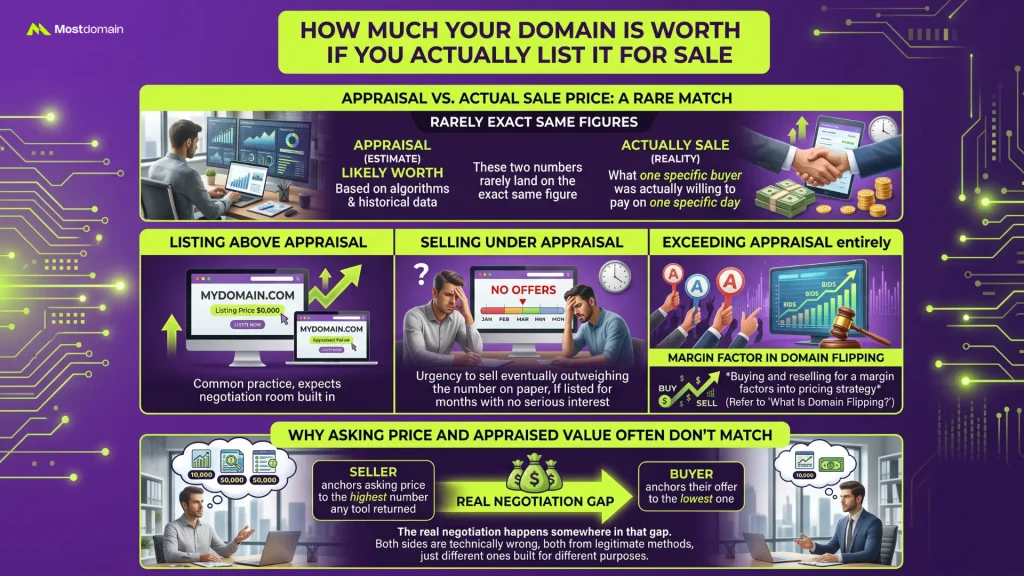
An appraisal estimates what a domain is likely worth, while a sale reflects what one specific buyer was actually willing to pay on one specific day, and those two numbers rarely land on the exact same figure.
Marketplace Listing Price vs. Actual Sale Price
- Listing above the appraised range is common practice, since most marketplaces expect some negotiation room built in
- A domain can sell well under its appraised value if it sits listed for months with no serious interest, since urgency to sell eventually outweighs the number on paper
- Auction-style listings sometimes exceed appraised value entirely when two buyers get into a genuine bidding war over the same name
- What Is Domain Flipping? covers how buying and reselling for a margin factors into pricing strategy for anyone treating this as an ongoing activity rather than a one-off sale
Why Asking Price and Appraised Value Often Don’t Match
Sellers tend to anchor an asking price to the highest number any tool returned; buyers anchor their offer to the lowest one. The real negotiation happens somewhere in that gap. Neither side is technically wrong here, since both numbers came from legitimate methods, just different ones built for different purposes.
Where Self-Valuation Usually Goes Wrong
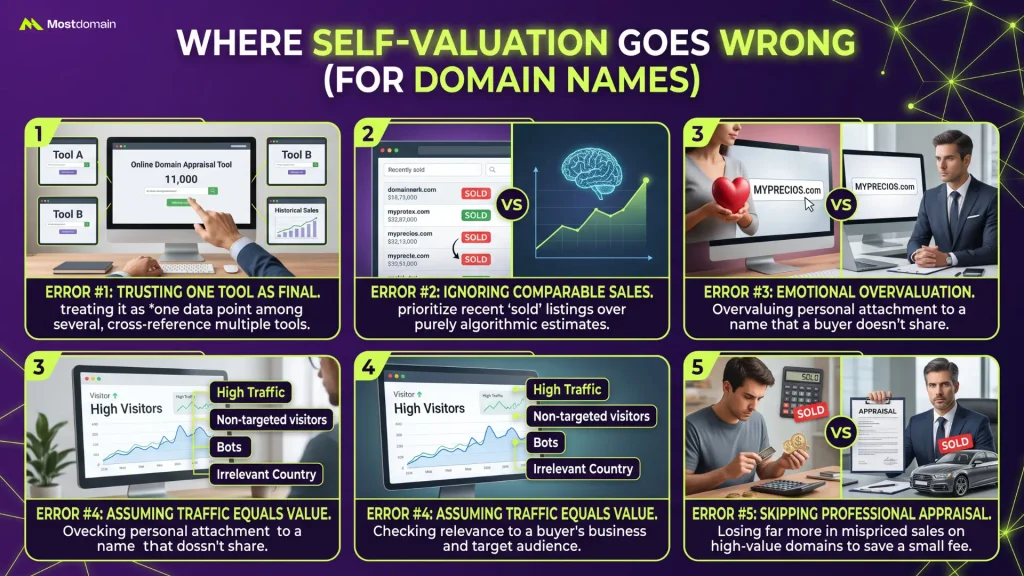
A handful of avoidable errors distort most self-assessed domain valuations before a listing even goes live.
- Trusting a single tool’s number as final, rather than treating it as one data point among several
- Ignoring comparable sales entirely and relying purely on algorithmic estimates that may not reflect current market conditions
- Overvaluing personal or emotional attachment to a name that a buyer has no similar attachment to
- Assuming traffic alone guarantees value without checking whether that traffic is actually relevant to a buyer’s business
- Skipping a professional appraisal on a high-value domain to save a small fee, then losing far more in a mispriced sale
FAQ
Is a free domain appraisal tool accurate enough to set a real price?
For domains under a few thousand dollars in estimated value, generally yes, especially when cross-referenced against comparable sales. Above that range, a professional appraisal becomes worth the added cost and accuracy.
Why did my domain get a $0 or very low appraisal?
Keyword search volume and comparable sales carry heavy weight in most free tools, which is why a made-up brandable name with no search volume and no similar recent sales can appraise near zero, despite having real commercial potential to the right buyer.
Does domain traffic always increase its value?
Not automatically, no. Relevance to a plausible buyer’s business is what makes traffic add value; unrelated or low-quality traffic barely moves an appraisal either way.
How often should I re-check my domain’s value?
Once or twice a year covers it for a domain that isn’t actively for sale, since comparable sales data and market demand shift gradually over time. A fresh check right before listing it for sale is worth doing regardless of when the last one happened.
Can a domain be worth more than what any tool estimates?
Yes, whenever a specific buyer has a strategic reason to want that exact name, a brand match or a competitive reason, that no algorithm could ever anticipate in advance.
References
- Bluehost, How Much is My Domain Worth? A Beginner’s Guide to Domain Valuation
- Network Solutions, How much is my domain worth: Guide to estimating domain value
- Name.com, How much is my domain worth?
- HostPapa, How Much Is My Domain Worth? Domain Value Guide