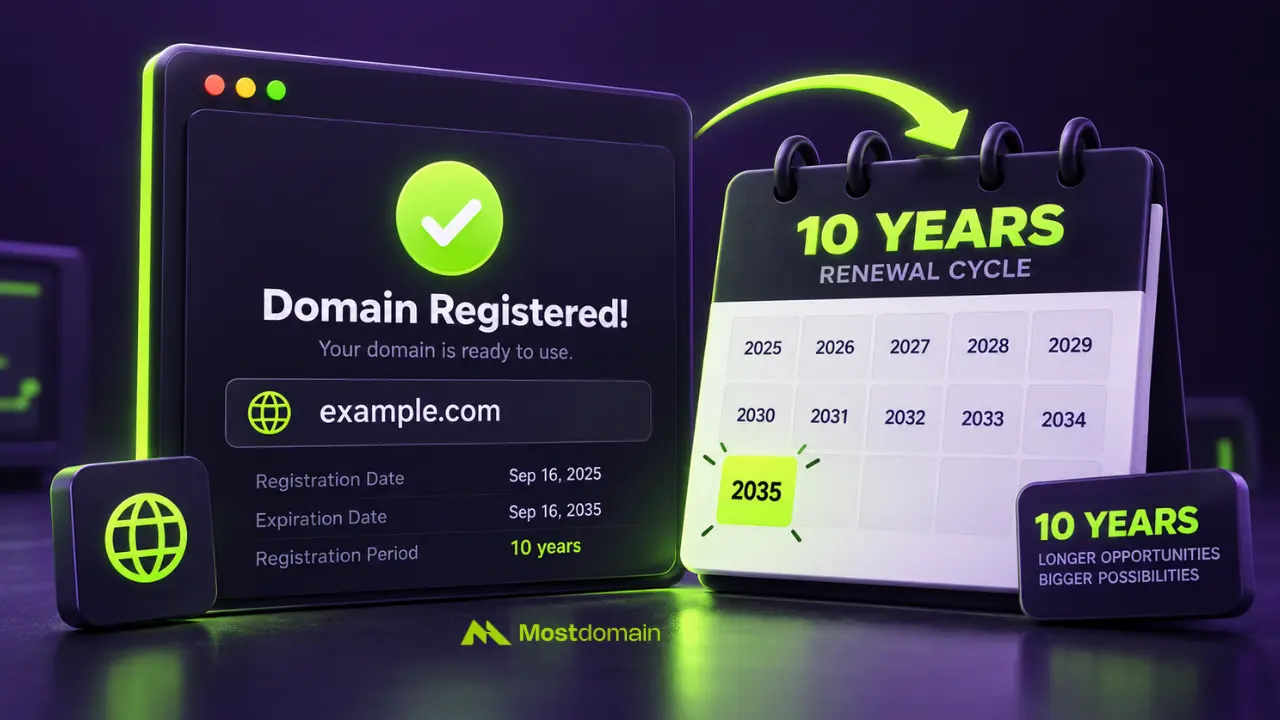
Short answer for how to buy a domain name permanently: you can’t, not in the literal sense, but a handful of specific tactics get remarkably close, close enough that “permanent” stops feeling like an exaggeration for most practical purposes.
Ten other articles online answer this exact question with roughly the same three paragraphs. This one goes further, into lifetime lease pacakages worth questioning, blockchain domains as an actual alternative, and the succession planning nobody else seems to mention.
Nothing here strays into anything else domain-related outside this specific question. Just permanence, what’s realistic, and what to watch out for.
Can You Actually Buy a Domain Name Permanently
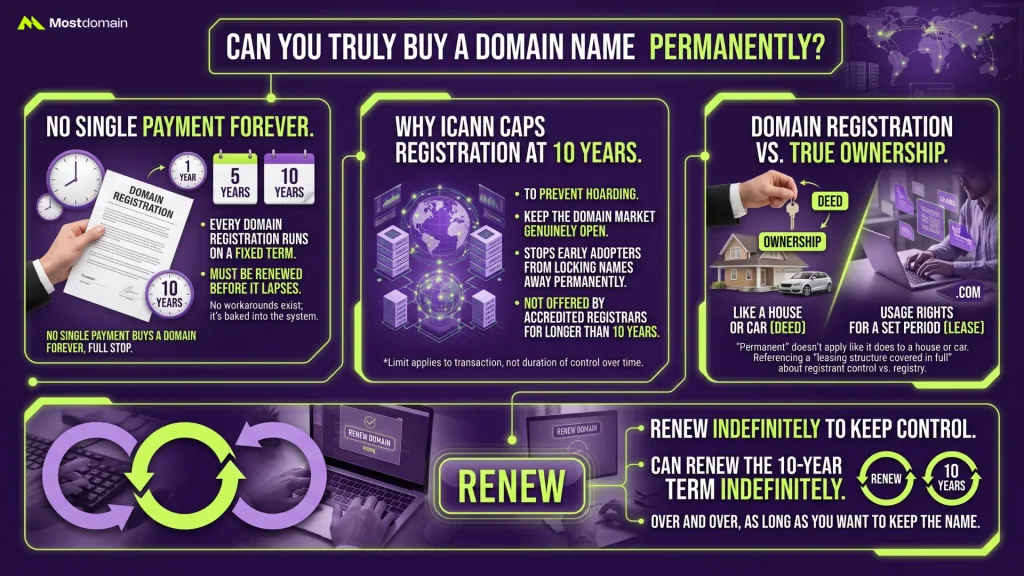
No single payment buys a domain forever, full stop, because every domain registration runs on a fixed term that has to be renewed before it lapses. That’s not a workaround or a loophole waiting to be found. It’s baked into how the entire system operates.
Why ICANN Caps Domain Registration at 10 Years
A ten-year ceiling on any single registration transaction exists specifically because ICANN designed the system to prevent hoarding and keep the domain market genuinely open rather than locked up by whoever registers first.
- Registering for longer than 10 years in one transaction isn’t offered by any accredited registrar, because the policy itself doesn’t allow it
- Nothing stops renewing that same 10-year term indefinitely, over and over, for as long as someone wants to keep the name
- Without this cap, early adopters of valuable names could lock them away permanently, cutting off future competition entirely
- The limit applies to the registration transaction itself, not to how long a person or company can actually control a domain over time
Domain Registration vs. True Ownership
A registrant holds usage rights for a set period, not a deed, and that distinction is the entire reason “permanent” doesn’t apply cleanly to domains the way it does to a house or a car. How to Register a Domain Name covers this leasing structure in full, along with what a registrant actually controls versus what stays with the registry.

How Close to Permanent You Can Actually Get
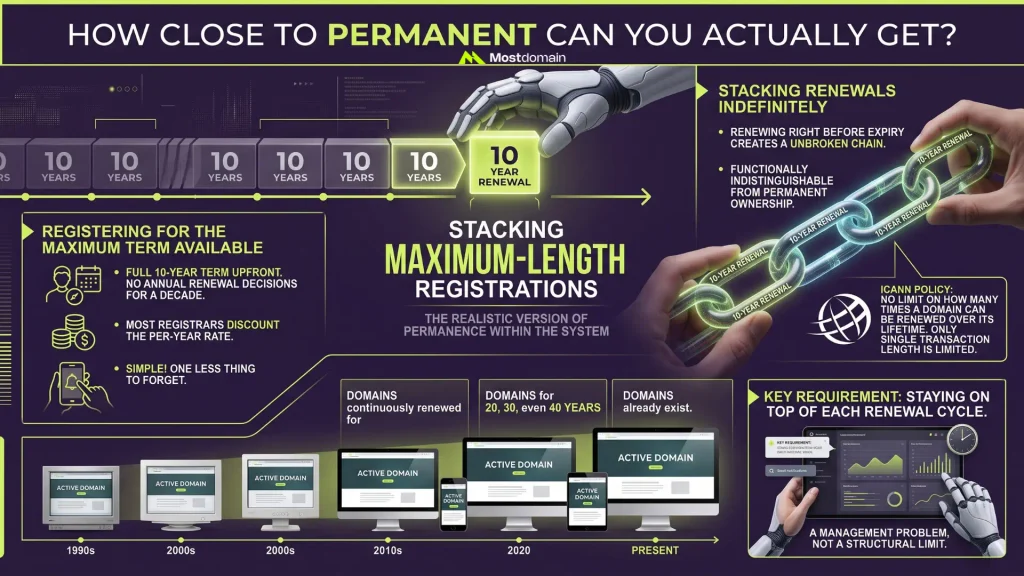
Stacking maximum-length registrations back to back, one after another without gaps, is the realistic version of “permanent” that actually exists within the current system.
Registering for the Maximum Term Available
Paying for a full 10-year term upfront removes the annual renewal decision from the calendar for a decade, and most registrars discount the per-year rate for committing to that length in a single transaction. It’s also simply one less thing to forget about each year.
Stacking Renewals Indefinitely
- Renewing a 10-year registration right before it expires, then doing that again a decade later, produces something functionally indistinguishable from permanent ownership
- Nothing in ICANN policy limits how many times a domain can be renewed over its lifetime, only how long any single renewal transaction can run
- Domains that have been continuously renewed for 20, 30, even 40 years already exist and keep working exactly the same way a domain registered last week does
- The only real requirement is staying on top of each renewal cycle, which is a management problem, not a structural limit
Why “Lifetime Domain” Packages Deserve Extra Scrutiny
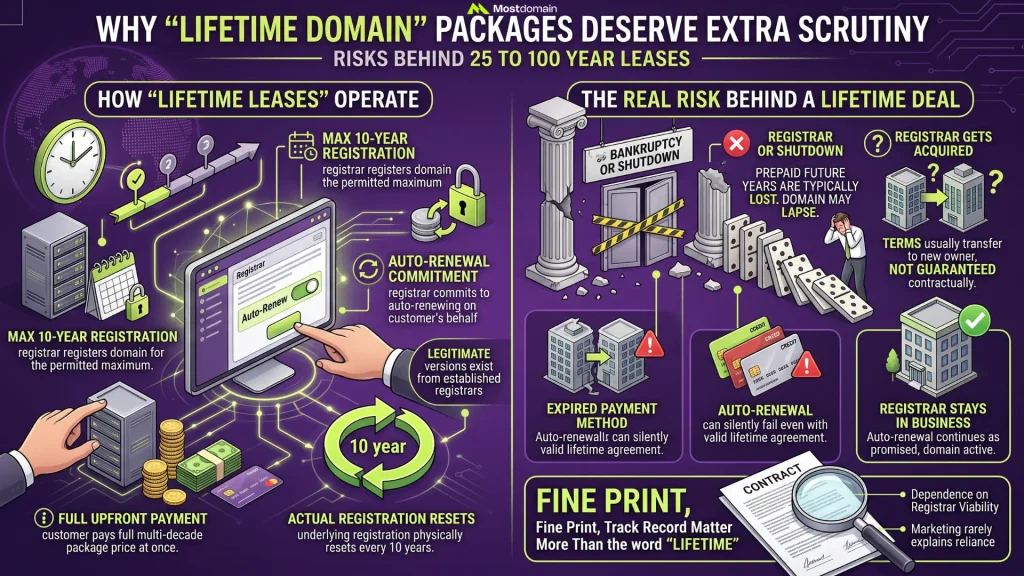
A “lifetime” or 25-to-100-year domain lease sounds like it solves the permanence problem outright, and in a narrow technical sense it does, just not in a way that’s risk-free.




How Some Registrars Package 25 to 100 Year “Leases”
- These packages work by registering the domain for the maximum 10-year term allowed, then having the registrar commit to auto-renewing it on the customer’s behalf for the remaining decades
- The customer pays upfront for the full lifetime package, while the actual registration underneath still resets every 10 years like any other domain
- Marketing language around these deals rarely explains that the “lifetime” promise depends entirely on that registrar staying in business and honoring the commitment
- Legitimate versions of this do exist from established registrars, so the packaging itself isn’t inherently a scam
The Real Risk Behind a Lifetime Domain Deal
A registrar going out of business mid-contract is the single biggest risk with any lifetime lease, since the prepaid years of future renewals disappear along with the company offering them.
| Scenario | What Happens |
| Registrar stays in business | Auto-renewal continues as promised, domain stays active |
| Registrar goes bankrupt or shuts down | Prepaid future years are typically lost; domain may lapse if nobody catches the missed renewal |
| Registrar gets acquired | Terms usually transfer to the new owner, though this isn’t guaranteed contractually |
| Payment method on file expires | Auto-renewal can silently fail even with a valid lifetime agreement in place |
None of this means lifetime packages are worth avoiding outright. It just means the fine print, and the registrar’s actual track record, matter more than the word “lifetime” printed on the sales page.
Are Blockchain Domains a Real Path to Permanent Ownership
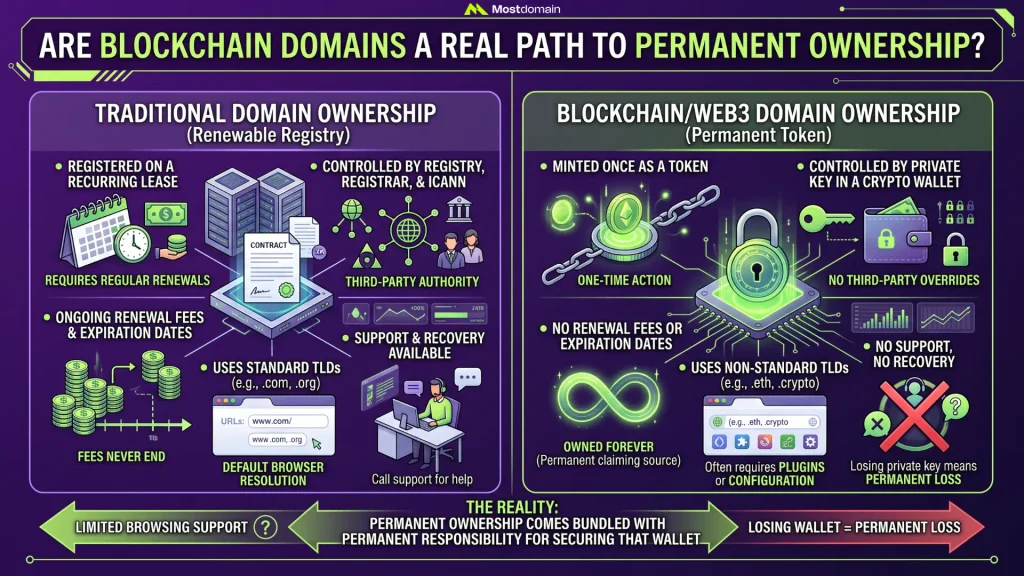
Blockchain-based domains genuinely do offer permanent ownership in a way traditional domains structurally can’t, because control lives in a crypto wallet rather than a renewable registry contract.
How Web3 Domains Work Differently
- A Web3 domain gets minted once, as a token, rather than registered on a recurring lease
- Whoever holds the private key to the associated wallet controls the domain completely, with no registrar, registry, or ICANN sitting above that ownership
- No renewal fees, no expiration date, and no third party with override authority exist in this model, which is the actual source of the “permanent” claim
- These domains typically use extensions outside the standard TLD system entirely, such as .crypto or .eth, rather than familiar options like .com
Why Web3 Domains Aren’t a Drop-In Replacement Yet
Most standard browsers don’t resolve Web3 domains without a plugin or special configuration, which means a .crypto or .eth address doesn’t work the same way typing mostdomain.com into a browser does for most visitors. Losing access to the wallet holding the domain also means losing the domain permanently, with no registrar support line to call for recovery. Permanent ownership, in this model, comes bundled with permanent responsibility for securing that wallet.
Protecting a Domain You Intend to Keep Forever
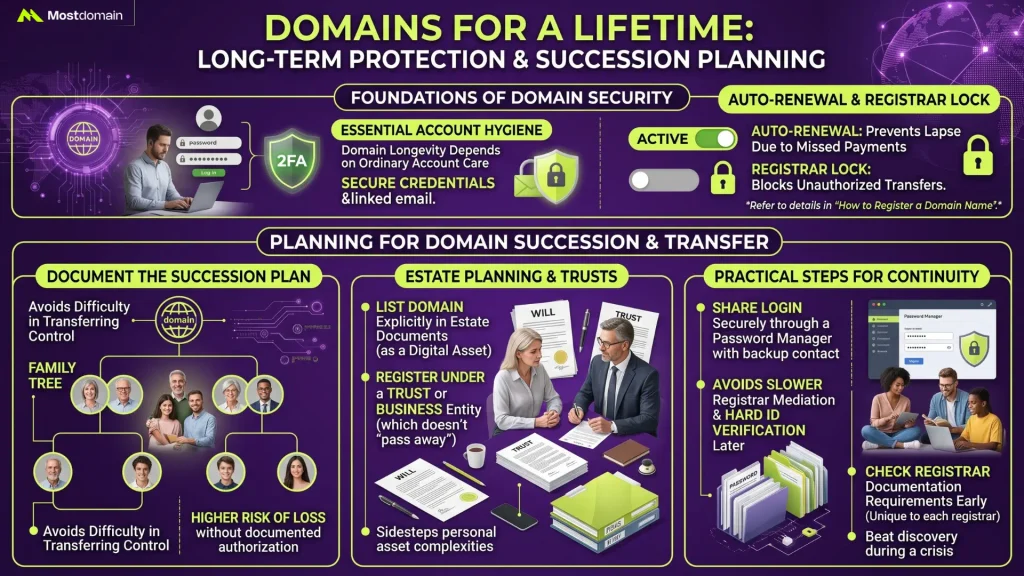
A domain meant to last indefinitely still depends entirely on ordinary account hygiene, since none of the permanence strategies above matter if the underlying account gets compromised or simply forgotten.
Auto-Renewal and Registrar Lock, Briefly
Auto-renewal and registrar lock both play a role in keeping a domain from lapsing or getting transferred without authorization, and How to Register a Domain Name walks through both settings, along with their specific risks, in detail.
Planning for Domain Transfer to an Heir or Successor
A domain with no documented succession plan can become genuinely difficult to recover if the registrant passes away or becomes unreachable, since registrars generally require proof of authority before transferring control to anyone else.
- Listing a domain explicitly in estate planning documents, alongside other digital assets, gives an executor a documented basis to request transfer
- Sharing registrar login credentials through a secure password manager with a designated backup contact avoids the slower, harder path of registrar-mediated identity verification later
- Registering under a trust or business entity rather than a personal name sidesteps some of this complexity entirely, since the entity itself doesn’t “pass away”
- Registrars each have their own documentation requirements for this kind of transfer, so checking the specific process in advance beats discovering it during a crisis
Keeping Business Domain Ownership Continuous Through Company Structure
Registering a domain under a business entity rather than a founder’s personal name keeps the domain tied to the company itself, which means it survives leadership changes, acquisitions, or a founder’s departure without needing any transfer paperwork at all.
What Happens If a “Permanent” Domain Lapses Anyway
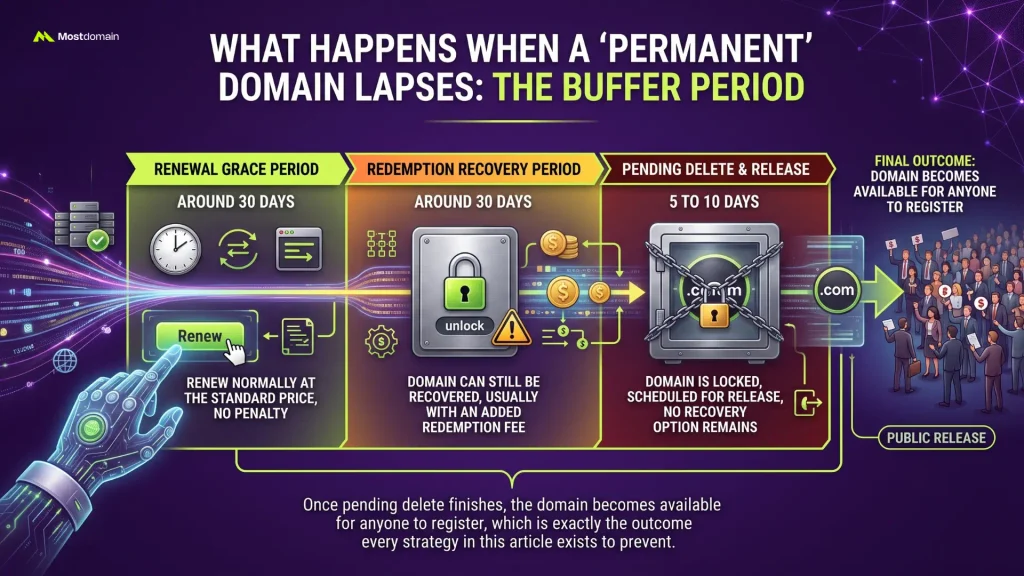
A domain that misses its renewal doesn’t disappear immediately, since a buffer period exists specifically to catch accidental lapses before a name becomes available to the public again.
The Grace, Redemption, and Pending Delete Stages
| Stage | Typical Duration | What’s Possible |
| Grace period | Around 30 days | Renew normally at the standard price, no penalty |
| Redemption period | Around 30 days | Domain can still be recovered, usually with an added redemption fee |
| Pending delete | 5 to 10 days | Domain is locked, scheduled for release, no recovery option remains |
Once pending delete finishes, the domain becomes available for anyone to register, which is exactly the outcome every strategy in this article exists to prevent.
FAQ
Is there any registrar that offers truly permanent domain registration?
No accredited registrar can offer that under current ICANN policy, since the 10-year cap applies industry-wide. Any “permanent” or “lifetime” offer is a renewal commitment layered on top of that same underlying structure, not an exception to it.
Does paying more money ever buy a longer registration term?
No. The 10-year maximum applies regardless of price, and no amount of money changes that ceiling for a single registration transaction on a standard TLD.
Can a domain be inherited like other property?
Yes, functionally, through the account access and documentation methods covered above, even though a domain itself isn’t legal property in the traditional sense. Whoever controls the registrar account and registrant details effectively controls the domain going forward.
Are Web3 domains recognized by ICANN?
No. Web3 domains operate entirely outside the ICANN-governed domain name system, on blockchain infrastructure instead, which is exactly why they aren’t bound by the same 10-year registration limit.
What’s the single biggest threat to keeping a domain “forever”?
An expired payment method tied to auto-renewal, more than anything else. Even a domain registered for the maximum term and set to auto-renew can still lapse silently if the card on file stops working and nobody notices in time.
References
- BigRock, How to buy a domain name permanently
- Hosted.com, Can You Buy A Domain Name Permanently?
- GoDaddy, Can you really buy a domain name permanently?
- Atom, Can You Buy a Domain Name Forever? (Permanently)