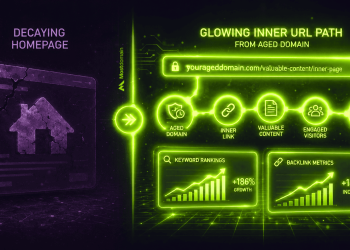



When you buy expired domain names, you skip years of authority-building. The domain already has backlinks, age, and possibly residual traffic. Done right, it compresses your timeline to ranking by a significant margin. Done wrong, you inherit someone else’s penalty history.
The Real Reason SEO Professionals Hunt Expired Domains
New domains start with zero. No backlinks, no trust signals, no crawl history. Search engines treat them cautiously for months. An expired domain that spent five years as a niche authority blog? Entirely different dynamic.

Backlink count gets most of the attention. It shouldn’t. Age is the harder variable to replace, because Google treats registration history as a proxy for sustained relevance, especially in contested keyword spaces. Something registered in 2014 and kept active leaves a footprint no new registration can manufacture. A year of rebuilding, sometimes two, before that gap actually closes.
Brand residue is another underappreciated factor. Some domains leave traces: social mentions, forum citations, newsletter archives that still point back. None of it surfaces in a standard DA checker. But it contributes to how fast a rebuilt site gains traction. Worth factoring in before you place a bid.
Metrics That Actually Matter Before You Bid
Six data points separate the acquisitions worth pursuing from the ones you’ll regret.
| Metric | Threshold | Why It Matters | Tool |
| Domain Authority | 20+ general; 40+ if you’re in a genuinely contested vertical | DA is a blunt instrument, but below 20 there’s usually not enough link mass to move the needle in any reasonable timeframe | Moz |
| Backlink Profile | Editorial only | One link from a real editorial source outweighs 200 directory submissions. Check the ratio, not the total. | Ahrefs, Majestic |
| Spam Score | Under 5% | Non-negotiable | Moz Link Explorer |
| Domain Age | 5+ years | Google’s treatment of newer domains in competitive spaces is notably cautious during what practitioners call the “sandbox” period, which can stretch 6 to 12 months on its own, independent of backlink quality | Whois |
| Historical Relevance | Thematic match to your use case | If the domain previously ranked for auto repair and you’re building a financial blog, the backlink equity transfer will be minimal at best | Wayback Machine |
| Penalty Status | Clean | Verify post-transfer | Google Search Console |
Those numbers don’t usually coexist honestly. Inflated authority through directory submissions or link schemes rarely passes meaningful value once Google reassesses the domain under new ownership. The signal that matters most is anchor text distribution: Ahrefs’ guide on expired domain evaluation walks through exactly which patterns to flag before any bid.
Where to Find Expired Domains for Sale
Several platforms aggregate expiring and expired domains. Running just one tends to leave gaps.
Mostdomain
Expired domain names without the tab overload. Mostdomain pulls verified backlink and authority data into one interface, cutting out the step where you cross-reference three separate audit tools before making a call. A practical starting point before widening the search.
GoDaddy Auctions
The largest expiring domain volume available anywhere. Bidding wars are common for domains with decent metrics, so set a hard ceiling before entering. You’ll find both naturally expired names and aftermarket listings from owners who chose to sell outright.




Namecheap Marketplace
Slightly lower competition than GoDaddy for mid-tier domains. The filtering options let you sort by DA, domain age, and extension. Useful for finding overlooked names in non-.com extensions where competition thins out.
ExpiredDomains.net
Free to use, pulling data from multiple registrars daily. The interface isn’t polished, but the coverage breadth is hard to beat for initial sweeps. Most buyers use it to build shortlists before running deeper paid audits elsewhere.
SpamZilla
Purpose-built for spam detection. Over 80 filters and proprietary backlink analysis. If you’re buying expired domain names at any real volume, the subscription pays for itself within the first acquisition cycle.
Always check the redemption window when you buy expired domain names through auction. Some registrars allow original owners to reclaim a domain for several weeks after expiration, occasionally after your bid has already won.
What Happens After You Own It
Acquisition is the easier half. What comes after determines whether the investment delivers.
For 301 redirects, thematic relevance is not optional. Pointing a fitness blog domain toward a SaaS company’s main site will produce little to no SEO transfer. Google’s contextual evaluation has become accurate enough that mismatched redirects often register as manipulative signals rather than genuine authority consolidation.
Rebuilding as a standalone site takes longer but tends to hold better. Restore content that mirrors the domain’s previous topic focus. A handful of posts aligned with what the domain ranked for before signals continuity to crawlers re-evaluating the property. Mostdomain’s team recommends treating the first 90 days post-acquisition as a foundation period, not an expectation window.
Domain flipping follows different logic. Acquisition cost discipline matters more than finding the “perfect” domain. A $40 acquisition with DA 25 and clean backlinks can realistically flip for $400 to $800 through direct outreach to niche buyers or marketplaces like Flippa. Margins compress fast when overbidding becomes a habit.
Risks That Most Buyers Overlook
Trademark disputes are the most financially damaging mistake in expired domain acquisition. Legal purchase doesn’t close the trademark question. Former brand owners retain UDRP standing even years after a domain expires, provided they can demonstrate active rights. Before bidding on anything with a branded appearance, USPTO, EUIPO, and WIPO lookups are non-negotiable. One overlooked name, and the arbitration cost alone exceeds most acquisition budgets.
Layered on top: data privacy obligations. Domains that collected user data from EU residents may carry GDPR-adjacent questions, particularly around archived user records. Legal exposure on this is low for most acquisitions, but high-traffic legacy domains deserve a closer look before purchase.
One underused pre-purchase step: run the domain through Google Safe Browsing. Domains previously flagged for malware or phishing don’t just rank poorly. They trigger active browser warnings that make traffic rebuilding nearly impossible until the flag is formally resolved.
FAQ
What exactly qualifies as an expired domain name?
At its simplest: a domain someone registered, used for years, then stopped paying for. Once the renewal deadline passes, it enters a grace period, sometimes an auction, then eventually reopens for general purchase. What makes buying expired domain names appealing is that the domain often carries whatever authority and backlink equity it accumulated under previous ownership.
Are expired domains always less expensive than premium domains?
Not always. Popular expired domains with high DA and strong editorial backlink profiles often sell well above standard registration fees. An expired domain is typically cheaper only when the metrics are modest. In competitive niches, bidding regularly clears four figures before it slows down.
What signals point to a Google penalty before I buy?
Run the domain through Semrush or Ahrefs and look at the organic traffic history. Sudden vertical drops to near-zero with no subsequent recovery are what manual penalty patterns look like. Gradual decline is different. Full confirmation comes only post-transfer via Google Search Console, but the traffic chart usually tells enough of the story to make a call before bidding.
What about using expired domains in link networks?
Still against the guidelines, and the manual penalty risk hasn’t softened. Google’s spam detection has improved considerably at identifying PBN structures, particularly when domains show mismatched historical content paired with new artificial linking patterns. The durable use case for buying expired domain names is rebuilding genuine niche properties or 301 redirecting to contextually related sites, either of which can deliver real SEO value without the exposure.
Which TLDs are worth targeting when buying expired domains?
.com isn’t going anywhere as the default anchor for authority and resale value. Niche buys in education or media often perform better on .org and .net, where the extension reinforces credibility rather than undermining it. Regional extensions are a different calculation: .co.uk and .com.au carry real authority within their territory, but outside it, the transfer is weak. Redirecting a .co.uk into a global .com tends to underperform what buyers expect on paper.
When should I expect ranking movement after acquiring an expired domain?
Most clean acquisitions with relevant rebuilt content start showing measurable movement somewhere between month three and month six. Dormancy period matters more than most buyers plan for. Domains with penalty signals or extended dormancy periods may take considerably longer. The first 90 days are better framed as a re-establishment window than a ranking window.
References
- Ahrefs Blog: ahrefs.com/blog/expired-domains/
- Moz Domain Authority Guide: moz.com/learn/seo/domain-authority
- Google Search Central: developers.google.com/search/docs
- ICANN UDRP Policy: icann.org/resources/pages/udrp-2012-02-25-en
- Internet Archive Wayback Machine: web.archive.org