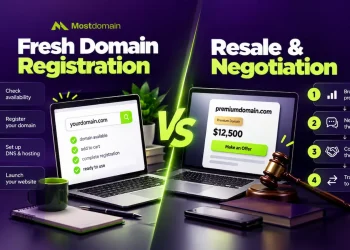
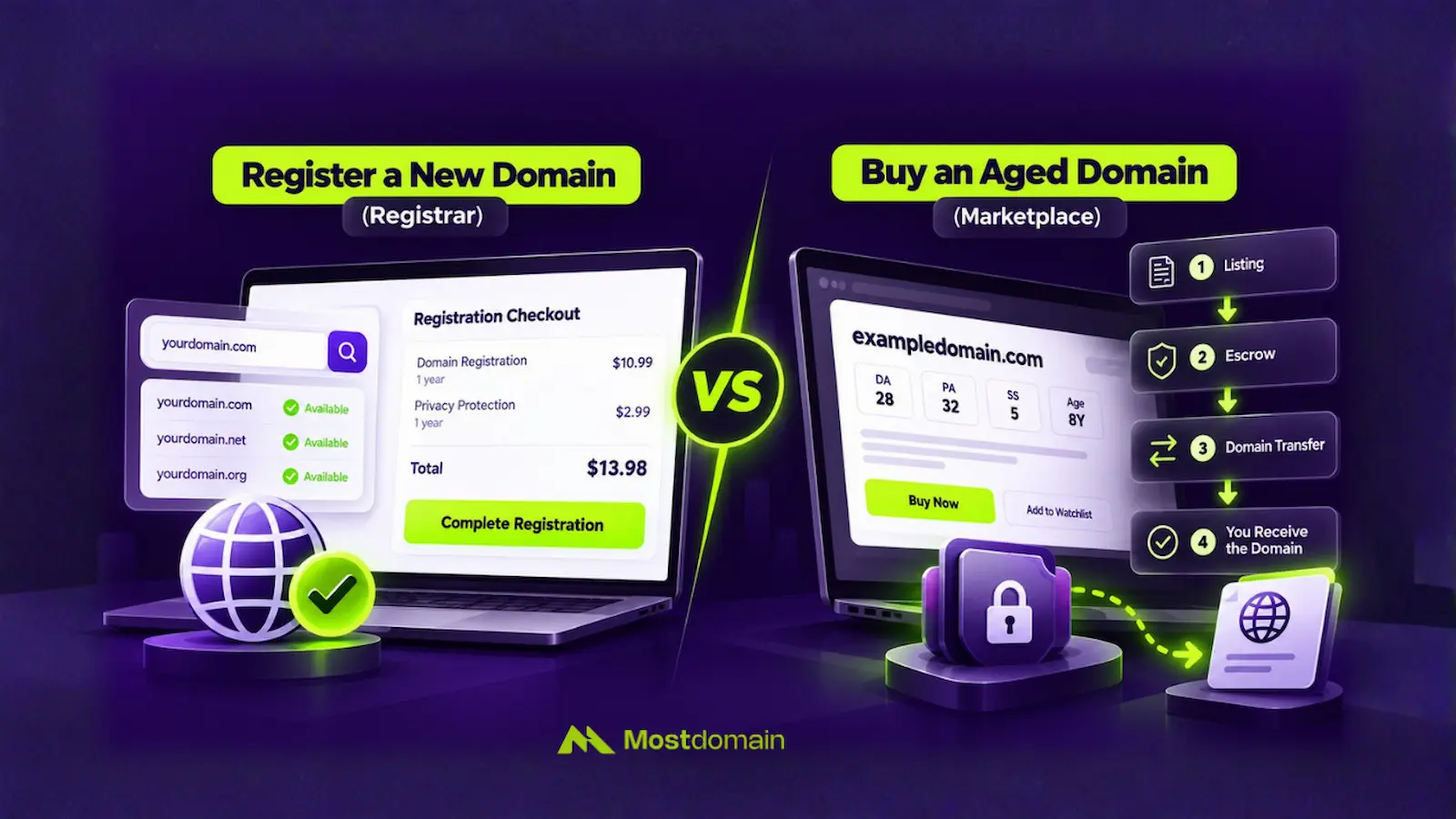
A domain registrar sells new, unregistered names at a fixed fee. A domain marketplace resells names someone already owns. One deals in fresh inventory. The other deals in names with a history and an existing owner attached.
This guide breaks down what each one does. It covers who profits, and when to use which.
The Short Version
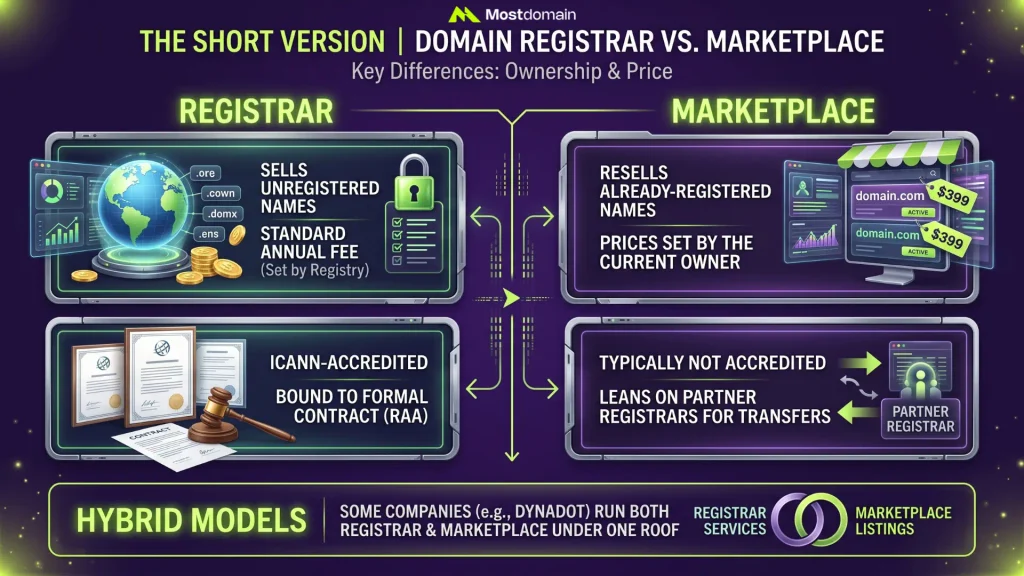
Ownership and price. That’s the whole split, boiled down.
- Registrars sell unregistered names at a standard annual fee, set by the registry.
- Marketplaces resell already-registered names, with prices the current owner sets.
- Registrars are ICANN-accredited and bound to a formal contract called the RAA.
- Marketplaces typically are not accredited themselves, and lean on partner registrars for transfers.
- Some companies, like Dynadot, run both a registrar and a marketplace under one roof.
What a Domain Registrar Actually Is
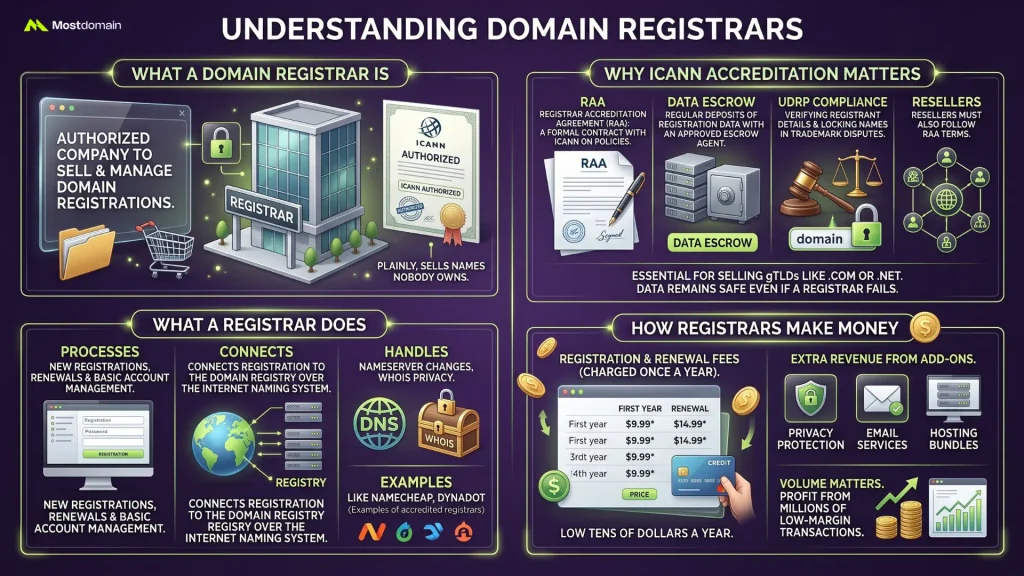
A company that’s authorized to sell and manage domain registrations. That’s a domain registrar, plainly.
What a Registrar Actually Does
Plainly, a registrar registers names that nobody currently owns.
- It processes new registrations, renewals, and basic account management.
- It connects your registration to the domain’s registry over the internet’s naming system.
- Nameserver changes, WHOIS privacy, things along those lines fall under its job too.
- Think Namecheap, or Dynadot. Both are accredited registrars people actually use.
Why ICANN Accreditation Actually Matters
Enforceable, ongoing obligations. That’s what accreditation really binds a registrar to.

| Obligation | What it requires |
| Registrar Accreditation Agreement (RAA) | A formal contract with ICANN covering consensus policies |
| Data escrow | Regular deposits of registration data with an ICANN-approved escrow agent |
| UDRP compliance | Verifying registrant details and locking names during trademark disputes |
| Reseller agreements | Any reseller must also follow RAA terms and consensus policies |
- The RAA’s data escrow rule exists so registrants stay protected. Even if a registrar fails, their data survives.
- Without accreditation, a company legally cannot sell gTLD registrations like .com or .net.
How Registrars Make Money
Registrars earn through registration and renewal fees, charged once a year.
- Low tens of dollars a year, typically, for a standard .com registration.
- Renewal pricing can differ from the first-year promotional rate. Always check both.
- Extra revenue often comes from add-ons: privacy protection, email, hosting bundles.
- Volume matters here. Registrars profit from millions of low-margin transactions.
What Is a Domain Marketplace?
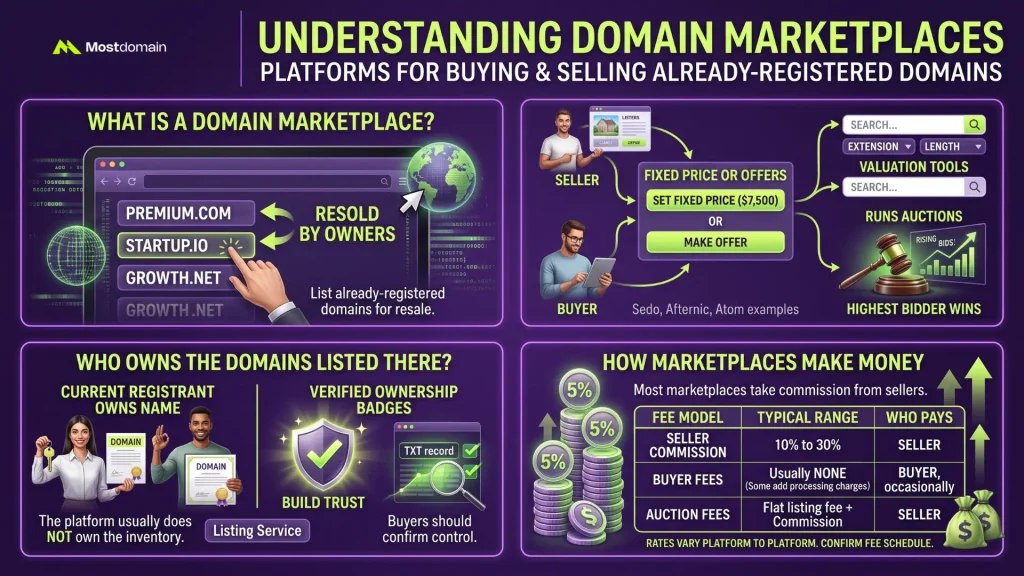
A domain marketplace is a platform where owners list already-registered domains for resale.
What a Marketplace Actually Does
Owners meet buyers there, plain and simple. That’s the marketplace’s whole function.




- A fixed price, or an open invitation for offers. Sellers choose either path.
- The marketplace hosts the listing, often with search filters and valuation tools.
- Many marketplaces run auctions too, where the highest bidder wins.
- Sedo, Afternic, and Atom are commonly cited examples in the domain trading space.
Who Owns the Domains Listed There
The current registrant owns every name on a marketplace. The platform itself usually does not.
- A marketplace is closer to a listing service than an inventory owner.
- Some platforms, though, hold their own portfolios and sell directly.
- Verified ownership badges help buyers trust a listing. Many rely on a DNS TXT record check.
- Buyers should confirm who actually controls the name before paying anyone.
How Marketplaces Make Money
Most marketplaces take a commission from the seller once a domain sells.
| Fee model | Typical range | Who pays |
| Seller commission | Often 10% to 30%, depending on the platform | Seller |
| Buyer fees | Usually none, though some platforms add processing charges | Buyer, occasionally |
| Auction fees | A flat listing fee, plus commission on the winning bid | Seller |
Rates vary a lot between platforms. Confirm the current fee schedule before you list or bid.
Domain Registrar vs Domain Marketplace: Key Differences
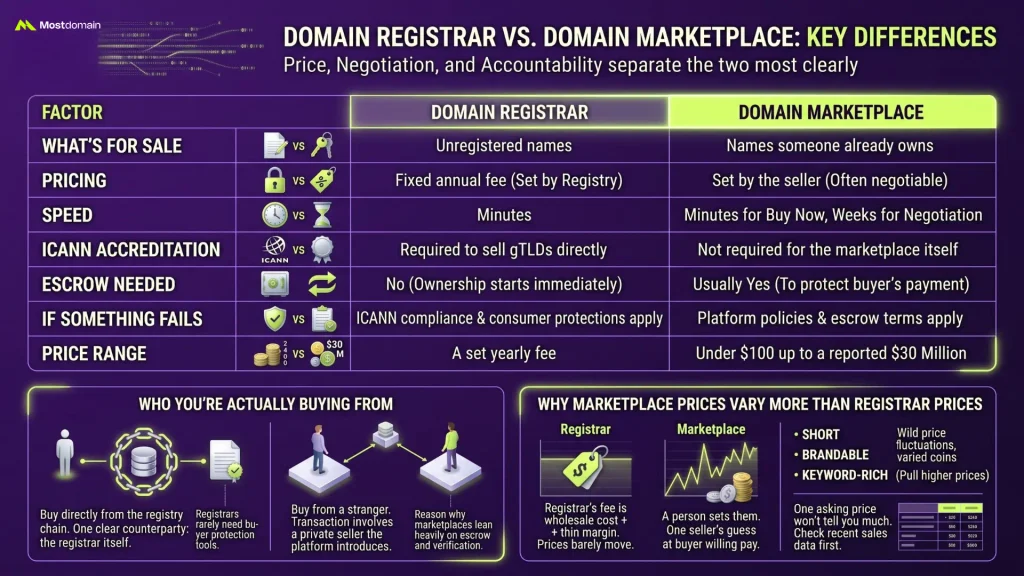
A domain registrar sells fresh names at a fixed price. A domain marketplace resells owned names, negotiated.
Feature-by-Feature Comparison Table
Price, negotiation, and accountability separate the two most clearly.
| Factor | Domain registrar | Domain marketplace |
| What’s for sale | Unregistered names | Names someone already owns |
| Pricing | Fixed annual fee, set by the registry | Set by the seller, often negotiable |
| Speed | Minutes | Minutes for Buy Now, weeks for negotiation |
| ICANN accreditation | Required to sell gTLDs directly | Not required for the marketplace itself |
| Escrow needed | No, ownership starts immediately | Usually yes, to protect the buyer’s payment |
| If something fails | ICANN compliance and consumer protections apply | Platform policies and escrow terms apply |
| Price range | A set yearly fee | Under $100 up to a reported $30 million |
Who You’re Actually Buying From
On a registrar, you buy directly from the registry chain. On a marketplace, you buy from a stranger.
- A registrar transaction has one clear counterparty: the registrar itself.
- A marketplace transaction involves a private seller the platform introduces you to.
- That difference is exactly why marketplaces lean so heavily on escrow and verification.
- Registrars rarely need buyer protection tools, since no prior owner exists.
Why Marketplace Prices Vary More Than Registrar Prices
Registrar prices barely move. Marketplace prices swing wildly, because a person sets them.
- A registrar’s fee is really the registry’s wholesale cost, plus a thin margin.
- Marketplace pricing works nothing like that. It’s one seller’s guess at what a buyer might pay.
- Short. Brandable. Keyword-rich. Those are the names that pull higher marketplace prices.
- One asking price alone won’t tell you much. Check recent sales data first.
Where Does the Domain Registry Fit In?
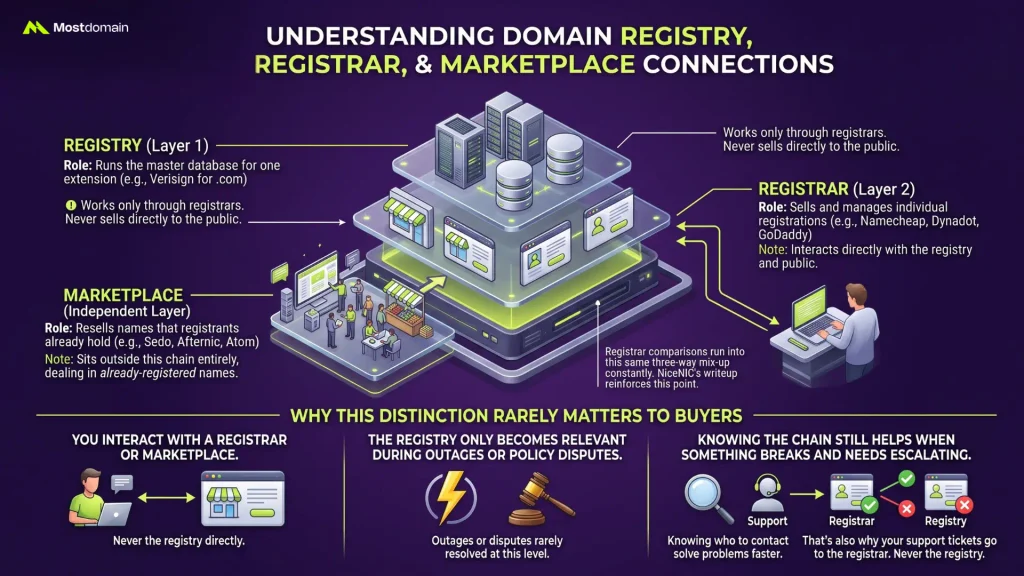
One level above every registrar sits the registry, running the extension itself.
How Registry, Registrar, and Marketplace Connect
Three layers, basically, and each one has its own job to do.
| Layer | Role | Example |
| Registry | Runs the master database for one extension | Verisign runs .com |
| Registrar | Sells and manages individual registrations | Namecheap, Dynadot, GoDaddy |
| Marketplace | Resells names that registrants already hold | Sedo, Afternic, Atom |
- The registry never sells directly to the public. It works only through registrars.
- A marketplace sits outside this chain entirely, dealing in already-registered names.
- Registrar comparisons run into this same three-way mix-up constantly. NiceNIC’s writeup on the topic makes basically the same point.
Why This Distinction Rarely Matters to Buyers
Honestly, most buyers never think about the registry at all.
- You interact with a registrar or marketplace, never the registry directly.
- The registry only becomes relevant during outages or policy disputes.
- Knowing the chain still helps, though, mostly when something breaks and needs escalating.
- That’s also why your support tickets go to the registrar. Never the registry.
Can a Company Be Both a Registrar and a Marketplace?
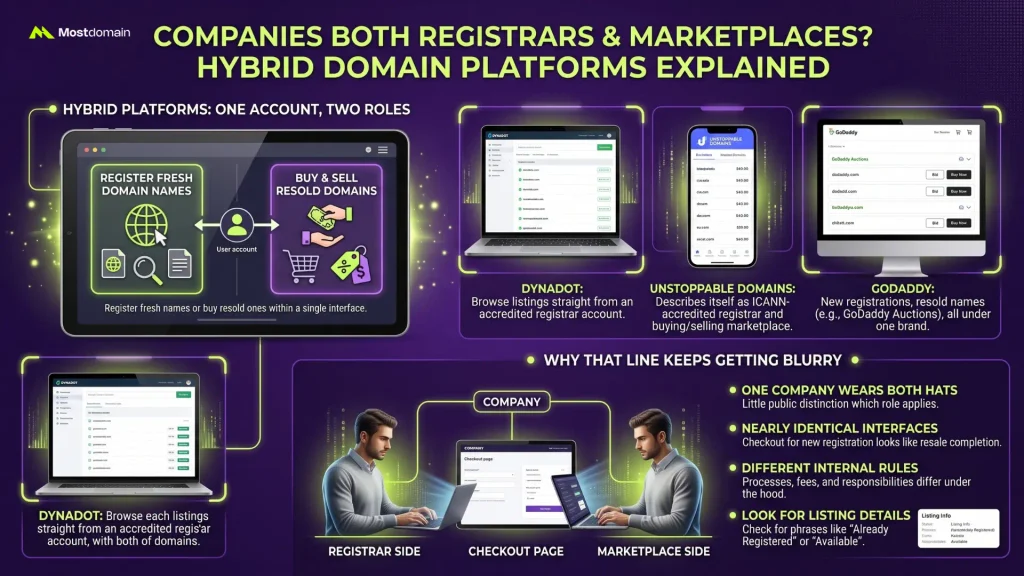
Yes, and more than a few do it. One accredited registrar arm, one resale marketplace arm, running together.
Hybrid Platforms Explained
A hybrid platform lets you do both in one account. Register a fresh name, or buy a resold one.
- Dynadot runs its own marketplace. Buyers browse listings straight from an accredited registrar account.
- Both an ICANN-accredited registrar and a buying-and-selling marketplace, that’s how Unstoppable Domains describes itself.
- New registrations, resold names through GoDaddy Auctions, all under one brand. That’s GoDaddy’s setup.
- In each case, the registrar side and the marketplace side follow different rules internally.
Why That Line Keeps Getting Blurry
The line blurs because one company can wear both hats. It rarely says which one applies.
- A checkout page might register a fresh name. Or it might complete a resale, using near-identical steps.
- Buyers rarely notice unless they check whether the name was already registered.
- Fee structures differ under the hood, even when the interface looks the same.
- Reading the listing details tells you which side of the business you’re on.
When Should You Use a Registrar Instead of a Marketplace?
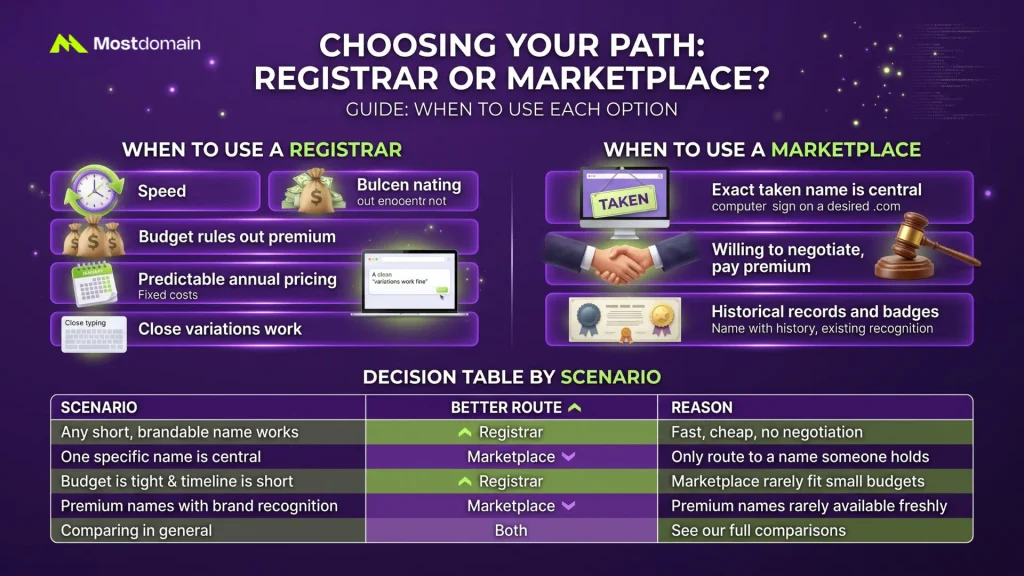
Use a domain registrar when any available name will do the job.
Situations Where a Registrar Is the Right Choice
Speed and budget win here, more than landing one exact word.
- You’re launching soon and a close variation works fine.
- Your budget rules out paying a premium to a private seller.
- You want predictable annual pricing with no negotiation involved.
- Standard steps for registering a domain name apply directly here.
Situations Where a Marketplace Is the Right Choice
A marketplace fits when one specific, already-taken name matters to your brand.
- The exact .com you want belongs to someone else.
- You’re willing to negotiate, wait, or pay above standard pricing.
- You want a name with history, existing backlinks, or brand recognition.
- Our full walkthrough on buying a domain name covers this path.
Decision Table by Scenario
Your flexibility on the exact name usually decides which route fits.
| Scenario | Better route | Reason |
| Any short, brandable name will work | Registrar | Fast, cheap, no negotiation needed |
| One specific name is central to your brand | Marketplace | Only route to a name someone already holds |
| Budget is tight and timeline is short | Registrar | Marketplace prices rarely fit small budgets |
| You want premium domain names with instant brand recognition | Marketplace | Premium names are rarely available for fresh registration |
| You’re comparing where to buy in general | Both, depending on the name | See our full comparison of best domain marketplaces and best domain registrars |
Which Is Safer, a Registrar or a Marketplace?
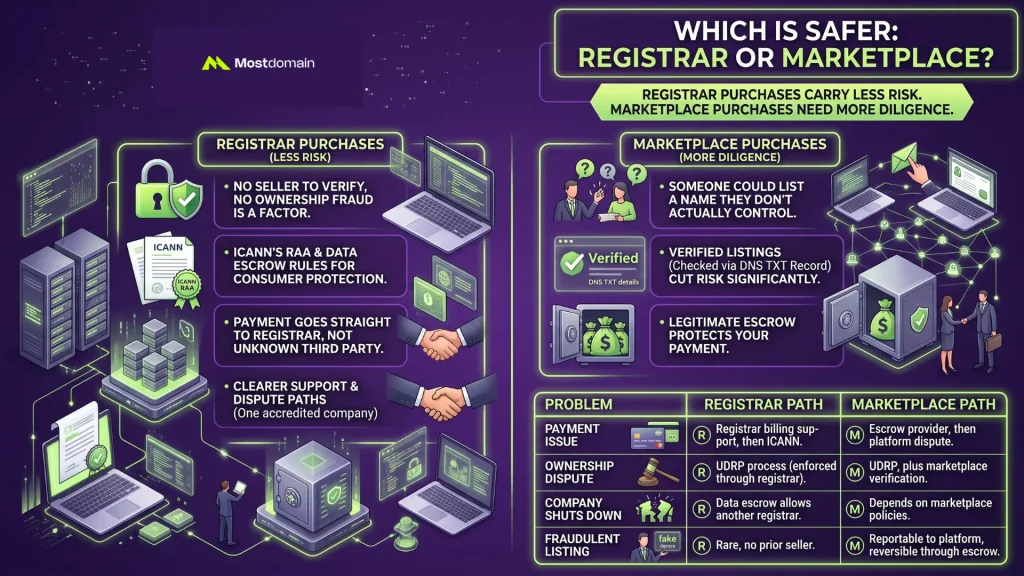
Registrar purchases carry less risk. Marketplace purchases need more of your own diligence.
Why Registrar Purchases Carry Less Risk
Registering a fresh name is low-risk because no prior owner exists to dispute it.
- There’s no seller to verify, so ownership fraud isn’t a factor.
- ICANN’s RAA and data escrow rules add a layer of consumer protection.
- Payment goes straight to the registrar, not to an unknown third party.
- Support and dispute paths are clearer, since one accredited company handles everything.
Why Marketplace Purchases Need Escrow and Verification
Because a private seller is involved, marketplace deals carry fraud and transfer risk.
- Someone could list a name they don’t actually control.
- Verified listings, checked through a DNS TXT record, cut this risk significantly.
- Legitimate escrow, opened directly through the provider’s own site, protects your payment.
- For a full breakdown of that process, read how the domain aftermarket actually works.
What Happens If Something Goes Wrong on Each
Registrar problems usually route through ICANN compliance. Marketplace problems route through the platform.
| Problem | Registrar path | Marketplace path |
| Payment issue | Registrar billing support, then ICANN if unresolved | Escrow provider, then the platform’s dispute process |
| Ownership dispute | UDRP process, enforced through the registrar | Same UDRP process, plus the marketplace’s own verification |
| Company shuts down | Data escrow lets another registrar take over | Depends entirely on the marketplace’s own policies |
| Fraudulent listing | Rare, since no prior seller exists | Reportable to the platform, sometimes reversible through escrow |
FAQ
Is a domain marketplace the same as a domain registrar?
No, they serve different functions in the domain buying process.
- A registrar sells unregistered names directly.
- A marketplace resells names an existing owner is willing to give up.
- Some companies run both sides at once. The functions, legally, never blur together though.
Do I still need a registrar if I buy from a marketplace?
Yes, because the completed transfer always lands in a registrar account.
- The marketplace facilitates the sale, but a registrar holds the final registration.
- You’ll typically transfer the name into your preferred registrar after purchase.
- For this part, a few marketplaces stay tied to one particular registrar.
Which is cheaper, a registrar or a marketplace?
Registrars are cheaper for fresh names. Marketplaces charge whatever the seller wants.
- A standard registration costs a fixed, low annual fee.
- From under $100 to seven figures, that’s the real spread on marketplace pricing.
- Compare recent sales data before assuming a marketplace price is fair.
Can I sell my domain through my registrar instead of a marketplace?
Some registrars offer their own resale or auction feature, so check first.
- GoDaddy Auctions and Dynadot’s marketplace are built-in examples.
- Without that feature, you’ll need a separate marketplace listing instead.
- Fees and exposure differ, so compare both options before choosing.
What is the difference between a registry and a registrar?
A registry runs one extension’s entire database. A registrar sells to individual customers.
- Verisign, for example, is the registry behind .com.
- You never buy directly from a registry as an end user.
- Registrars are the customer-facing layer between you and the registry.
Are domain marketplaces regulated by ICANN?
Not in the same way registrars are, since marketplaces aren’t registrars themselves.
- ICANN’s RAA applies specifically to accredited registrars.
- Marketplaces rely on partner registrars to complete the technical transfer.
- The platform handles buyer protection here. ICANN itself stays out of it directly.
Why do some domains cost more on a marketplace than at a registrar?
Because marketplace prices reflect demand for one specific name, not a wholesale rate.
- Nearly any available name costs the registrar the same flat fee.
- On a marketplace, though, pricing swings with brandability, length, whatever buyers happen to want.
- Real scarcity is what’s driving this, honestly. Only one person gets to own the exact name you’re after.
One Rule of Thumb Before You Choose
Most of the time, a registrar first. A marketplace only if nothing available fits.
- Many buyers jump straight to marketplace prices out of habit, and overpay for names.
- A five-minute registrar search often turns up something perfectly usable.
- The marketplace route is worth saving for one thing. A name you genuinely can’t replace.
- More money gets saved by that one decision than by haggling over fees later.
References
- ICANN, Accredited Registrars
- ICANN, Registrar Data Escrow Program Implementation Announcement
- ICANN, Compliance: Registrar Obligations
- Dynadot, Domain Market Help Center
- DomainMarket.com, Direct Seller vs. Open Marketplace vs. Domain Broker: How Should You Buy a Premium Domain?
- NiceNIC, NiceNIC vs Gname: Which Domain Registrar Is Better for Your Business?
- NameGULF, Domain Marketplace Frequently Asked Questions
- Wikipedia, Domain aftermarket