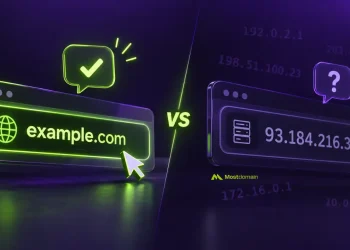

A domain name is an address. It’s an address you type into a browser to reach a website. It standing in for a long string of numbers. That number is known as an IP address. It usually pairs a unique word or phrase with an extension like .com, .net, or .org. Without that, a site has no real way of being found on the open web.
Think of it as a shortcut. Computers navigate the internet through numbers, not words. So the entire domain name system exists to make that process usable for actual people.
What Does a Domain Name Actually Mean
Picture a domain name as a stand-in for a website’s true location on a server, the same way a street address stands in for exact map coordinates. Nobody memorizes coordinates. They remember names.
That single idea explains why every serious website, from a global brand to a personal blog, starts with picking one:
- google.com, a business name paired with the most recognized extension on earth
- wikipedia.org, where .org signals a nonprofit mission rather than a product
- mostdomain.com, built around a niche the name itself explains
The Anatomy of a Domain Name
Every domain name breaks down into up to three parts:
- A subdomain
- A second-level domain
- Top-level domain (TLD)
though only the last two are required to make it functional.

| Part | Example in blog.mostdomain.com | What It Represents |
| Subdomain | blog | An optional section carved out of the main site |
| Second-Level Domain (SLD) | mostdomain | The unique name chosen at registration |
| Top-Level Domain (TLD) | .com | The extension, often hinting at purpose, industry, or region |
More than 1,593 TLDs sit in the IANA root zone database at last count. A fair jump from the handful of options available when the system first launched.
Domain Name vs URL vs Website vs Hosting
Mixing up a domain name with a URL, a website, or hosting ranks among the most common beginner mix-ups out there. If only because a domain name is really just one piece of a much larger puzzle.
Own the domain name, and you control the address. Rent the hosting, and you’re just borrowing the space it points to.




How a Domain Name Works With DNS
Behind every working domain name sits the Domain Name System. DNS translating it into the numeric IP address a computer actually needs to load the page.
- A visitor types a domain name into their browser
- The device asks a DNS resolver to look up the matching IP address
- That resolver checks the root zone database to identify which registry manages the relevant extension
- Once the address is found, the browser connects directly to the correct server. And also loads the site
This entire lookup process is coordinated globally through 13 root server clusters. Keeping the system synchronized no matter where in the world a request originates.
Why a Domain Name Matters for a Business or Brand
Well before a visitor sees a single product or reads a single line of copy, the domain name has usually already formed their first impression of the business.
- A name that matches the business is giving a real signals rather than a temporary storefront
- Short, relevant names get remembered and typed correctly far more often than clever, abstract ones
- Owning the domain name outright means branding decisions stay independent of any social platform’s rules
- Extension choice still carries weight: .com and .net together account for 44.9% of all registered domain names worldwide. Which says something about how much trust that particular extension still holds, at least for now
A Brief History of Domain Names
The first domain name was registered in 1985. Decades before most businesses had even considered building a website.
| Year | Milestone |
| 1985 | symbolics.com becomes the first registered .com domain name, on March 15 |
| 1988 | IANA formally takes over global address coordination |
| 1998 | ICANN is founded, breaking domain registration open to a competitive market of accredited registrars instead of a single gatekeeper |
| Today | 1,593 top-level domains and counting |
What started as a workaround for a handful of research computers eventually became the addressing system for a global economy. Nobody involved in 1985 planned for that. A quiet, accidental sort of infrastructure.
How Many Domain Names Exist Today
Roughly 392.5 million domain names were registered worldwide. It is by the end of Q1 2026, based on Verisign’s most recent industry report.
- .com and .net combined hold 176.1 million registrations. Still the largest single share by a wide margin.
- Newer generic extensions like .shop or .app added 49.6 million registrations. Growing 31.3% year over year, well ahead of legacy extensions.
- Country-code extensions such as .de, .uk, and .cn account for 146.3 million combined.
Some of that new-extension growth reflects genuine demand. Some of it just registrars bundling cheap add-on extensions at checkout. Worth keeping in mind before reading too much into any single number. Growth has not slowed. Registrations rose by 24.1 million, or 6.5%, compared to the same quarter a year earlier.
How to Get Your Own Domain Name
Getting a domain name takes three basic steps. First is pick a name! Then check its availability through a registrar. And last is complete registration. Usually fo`r one year at a time.
- Brainstorm something short, easy to spell out loud, and free of hyphens or numbers where possible
- Search availability across a few extensions. Since a first-choice .com is very often already taken
- Register through an ICANN-accredited registrar. Then renew annually (or multi-year) to keep ownership
- Consider an aged domain. The kind platforms like Mostdomain specialize in, if built-in history and existing authority matter more than starting completely from zero
Common Mistakes to Avoid When Choosing a Domain Name
Most domain name mistakes come down to prioritizing cleverness over clarity. And that usually costs more in lost traffic than it ever gains in branding points. Though the exact cost depends heavily on the industry.
- Picking a name that sounds confusing when spoken out loud, not just when read
- Leaning on an unusual extension customers are unlikely to remember later
- Skipping a basic trademark check before locking in a registration
- Choosing length and personality over simple memorability
- Ignoring a domain’s past use entirely, since some previously registered names carry baggage like spam flags or search penalties
None of this is complicated. It’s just easy to rush.
FAQ
Can a domain name be changed after a website has already launched
Yes, but switching means starting over. It starting over on backlinks, search rankings, and brand recognition that took time to build. Most businesses treat it as a last resort. Remember that its not a routine update.
Is a domain name the same thing as a website
No. A domain name only points visitors toward a website. The actual content, design, and functionality live somewhere else entirely, on a hosting server.
How long does a domain name registration actually last
Registrars typically require renewal every year. Although many allow locking in a term of up to ten years in advance for extra stability.
What happens if a domain name is not renewed on time
It usually enters a grace period first. Followed by a redemption period with added fees, before finally becoming available again for anyone to register.
Can two companies legally own domain names built from the same word
Yes, as long as the extensions differ. Since each TLD operates as a separate registry. So it could technically belong to two unrelated owners.
Does the extension of a domain name affect how it ranks in search results
Not directly. Search engines do not favor .com over .org or .net for ranking purposes. Though user trust and click-through behavior can still tilt slightly toward familiar extensions.
References
- Verisign, “DNIB.com Reports Internet Has 392.5 Million Domain Name Registrations at the End of the First Quarter of 2026”
- Wikipedia, “List of Internet Top-Level Domains”
- IANA, “Root Zone Database”
- Stackscale, “Symbolics.com Is the First Registered .com Domain Name”